Interactive Art — 2025
Luxtra
On request
The Walking Exhibit: How to Hack a Festival with Interactive Light
Luxtra was born as a pure happening project and an open experiment in the field of wearable technology. Its primary goal was to test the boundaries between the spectator and the artwork right in the scenery of a night city. The jacket served as an unaccredited, guerrilla exhibit at the Signal Festival in Prague, where it naturally blurred the line between the official program and a spontaneous street intervention within the crowd.
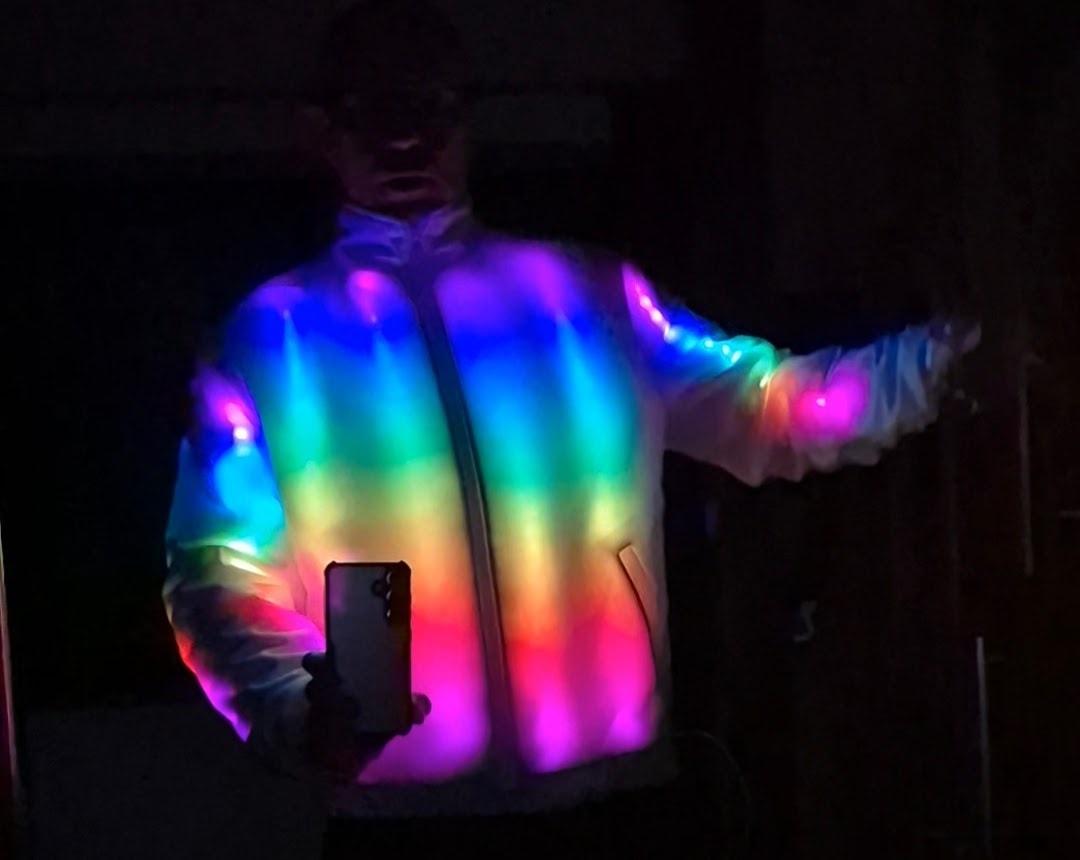
The core of the entire object is a custom-tailored jacket made of white windbreaker material, designed and crafted by my wife, Šárka. The fabric acts as a perfect diffuser—concealing the internal hardware structure and transforming the raw light from the LED strips into a soft, organically shifting light aura wrapping around the entire body.
Luxtra responds to its wearer in real time. Using motion sensors in the sleeves, it senses arm dynamics, gesture speed, and body position. The wearer becomes a living modulator, directly composing the lighting show with their movements—from smooth color gradients and rhythmic breathing to light snakes that literally shoot out of the sleeves and zip across the body.
Hardware Anatomy and the Virtual Cylinder
Integrating complex electronics into the lining of a textile garment required specific engineering solutions focused on flexibility and reliability.
Control Center and Power: The system is powered by a miniature ESP32-C3 microcontroller tucked away with the battery pack at the lower back. A total of 344 intelligent LEDs are mapped across 12 vertical segments on the torso and sleeves.
IMU Sensors: An MPU6050 accelerometer and gyroscope is implemented in each sleeve. Due to the length of the wiring running through the textile channels, the internal I2C bus is software-throttled to 50 kHz to ensure 100% data transmission stability even during abrupt movements.
Body Grid: The software (built on the Arduino framework and the FastLED library) maps the physical LED strips onto a virtual grid of 12 columns × 60 rows. This wraps the body like an abstract cylinder upon which mathematical and physical simulations run.
Kinetic Control and 7 Lighting Modes
The jacket requires no mechanical buttons. Global algorithm switching is handled via a double-twist gesture with the left hand—a rapid double rotation of the wrist back and forth (the firmware detects specific peaks on the gyroscopic Y-axis). The right hand then functions as a real-time parameter modifier.
Seven unique effects are programmed into the memory:
WristWaves: Waves of energy injected from the sleeves into the body based on movement intensity (jerk), changing color according to the arm angle.
RainPixels: A physics simulation of falling drops where gravity and the fall direction react to the tilt of both arms.
BiGradient: A smooth two-color gradient across the entire body, where the hands literally and physically "pull" the colors to their side.
Cells: Circular light bubbles that are born, grow, bounce off the grid boundaries, and gradually fade away.
Snake: Light snakes triggered by lifting arms away from the body. Snake segments shoot rapidly out of one sleeve, travel across the entire body through the front and back loops of the jacket, and disappear at the very end of the opposite arm.
Breathe: A single-color pulsing of the entire surface, where the breathing frequency depends on the arm span.
RainbowFlow: A vertical flow of the rainbow from top to bottom, with a speed directly proportional to the angle of the raised hands.
Specifications
- Dimensions
- 25×9×20 cm (W×H×D)
- Materials
- White Jacket, RGB Smart Led, ESP32-C3, Electronics, 3D Printing
- Year
- 2025
Projects are made to order. Scope, delivery timeframe, and price are agreed at the start of the project.